
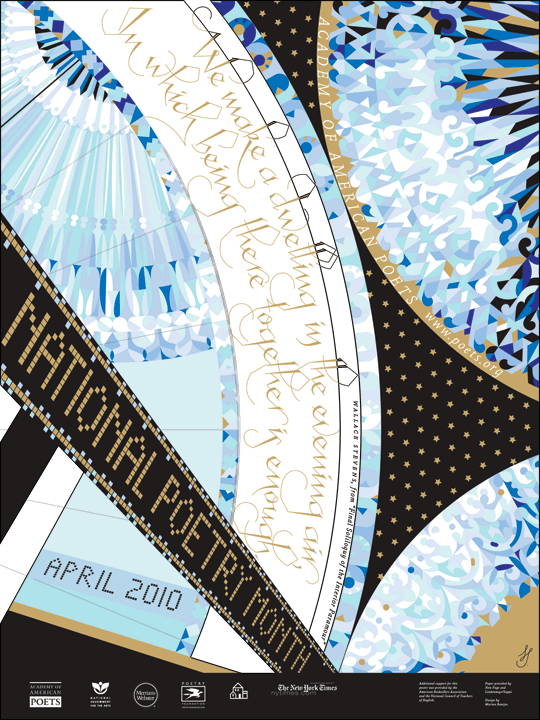
 A poem begins with a lump in the throat. ~Robert Frost
The only problem
with Haiku is that you just
get started and then
~Roger McGough
Poetry has the tendency to promote literacy skills in ways that can have a life-long impact on students.
As a 6th grade humanities teacher, I regularly shared favorite or timely poems. Every year in March, prior to our annual week at science camp, I would introduce haiku. Students immediately bought in to the format because “Hey, we only have to write three lines – and there’s a syllable limit!”
Something close to magical always happened as they began drafting, discovering on their own that with the line and syllable limits, “every word needs to count.” And the challenge was on to find the perfect word, which might have to be re-thought if the syllable count didn’t work for that line. They were hooked.
As we headed down the California coast towards science camp, at any given stopping point, such as the tide pools, I could see students, against the backdrop of sand and surf, silently counting on their fingers…counting syllables for the haiku they were composing in their heads. Each year, they returned from camp with notebooks a bit worn from the journey, but containing literary gems – just in time for April’s National Poetry Month. And each year I witnessed the power of poetry to inspire students to imagine more, to read more, and to write more.
In my current position as a technology integration specialist, I visit many school sites. Often, particularly at the elementary level, student poetry is boldly displayed on the classroom walls…just begging for a broader audience. New technologies, such as VoiceThread, for instance, make it increasingly easy for students to take their poetry beyond the classroom, out into the world. If you browse the VoiceThread gallery using “poetry” as a search term, you will quickly find hundreds of samples. To restrict your search to K12 samples only, switch to ed.voicethread. The VoiceThread Library has short articles to help you imagine the possibilities for combining images with power of the human voice.
Poetry, maybe more than any other genre, lends itself to multimedia writing and innovation. Phoetry (photograph + poetry), for example, is making its way into our language and into teachers’ toolkits. The samples shown on Flickr.com or on teacher educator Arnie Abrams‘ workshop handout (scroll to find Fog) will provide you with a window into this emerging genre. Blogger/teacher Bud Hunt invites you into his second annual NPM 2010. Throughout the month, he will post the daily photo “as a way to generate some prompts for folks who maybe wanted to write poetry, but needed a little push.“
If I could time-travel my former 6th grade students (mentioned above) into the present, it’s fun to think about how free tools, and step-by-step instructions – such as teacher Joyce Masongsong-Ray‘s Planning, Writing, and Animating Haiku PDF – and resources – such as Kevin Hodgson‘s Making Stopmotion site – for animating their poetry could transform their words from static notebook pages to dynamic stopmotion pieces, such as those produced by 5th grade students at Northside Elementary School.
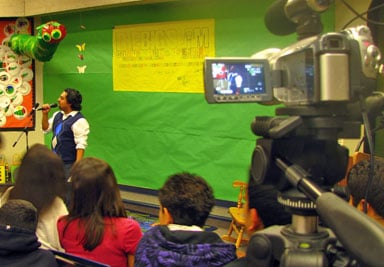
Teen Salinas Slam - Photo courtesy of Peter Kwiek
There are many ways to take a poem beyond paper and pencil – and, in the process, to build on students’ reading, fluency, vocabulary, comprehension, and self-confidence as writers. Sometimes community collaboration, a bit of technology, and a shared belief that all students are entitled to poetry can rock students’ worlds, pushing them to academic levels they had not dreamed possible. Teen Salinas Speaks, for example, illustrates the empowerment that comes from this synergy.

Photo courtesy of Peter Kwiek
This project stems from the vision of middle school teacher Natalie Bernasconi, who explains the steps: “Start with the support of the Central California Writing Project, then mix together a group of middle and high school teachers and students, add one very cool journalist / slam poet guest speaker to light a fire under them, then give them a community space at the local Salinas Public Library to meet in, and you’ve got Teen Salinas Speaks.” The upcoming Spring Slam will be captured electronically in both video and podcast form and shared via Teen Salinas Slam’s Facebook page as a social networking opportunity to extend the power of the spoken word to a virtual audience as well.
If you have been looking for lessons, new ideas and resources, and maybe a little inspiration to ignite your celebration of National Poetry Month, check out the ten sites I’ve listed below. I’m betting you’ll find at least one activity you can use tomorrow!
- Scholastic’s April Is National Poetry Month – Tons of ideas and resources to jump start your poetry unit. For the younger students, what could be more fun than having Jack Prelutsky, our Nation’s first Children’s Poet Laureate, sharing his voice and providing a little mentoring? There are plenty of resources for secondary students too, from Using Poetry to Explore and Change to interviews with Maya Angelo to awarding-winning 17-year old poet Meredith Weber, who invites you into her poet’s workshop. For cross-curricular ideas, check out Mr. Tang’s Math Riddles samples.
- Read/Write/Think – I’ve been a long-time fan of this NCTE (National Council for Teachers of English) site and have come to expect outstanding teacher-tested, research based resources like the ones posted for National Poetry Month. I recommend checking out the “interactives,” such as Diamonte Poems or What’s an Acrostic Poem? and then move on to sample some lessons, such as Poetry Portfolios for your primary students, Composing Cinquain Poems with Basic Parts of Speech for elementary students, or Is a Sentence a Poem? mini-lesson for secondary students. In addition to hosting the Read/Write/Think site, NCTE also posts a National Poetry Day page with podcasts from last year’s entries.
- National Writing Project – This organization (to which I’ve been a member for 15 years) is at the heart of how I approach the teaching of writing – including poetry. What you’ll find on their National Poetry Month and the National Writing Project site are Writing Project teachers, including Natalie Bernasconi, telling their stories and sharing their reflections and lessons learned about the place of poetry in their classrooms.
- Edsitement – Not be outdone by NCTE or NWP, the National Endowment for Humanities has also assembled some outstanding resources on their National Poetry Month: Forms of Poetry site. If you are looking for a unit on Langston Hughes, I recommend The Poet’s Voice – Langston Hughes and You, a scaffolded lesson that will address two central questions: What is meant by voice in poetry, and what qualities have made the voice of Langston Hughes a favorite for so many people? You might use this lesson as a starting point, and then revisit the NWP site to introduce Gavin Tachibana‘s creative idea to combine Langston Hughes’ poetry with Tibetan prayer flags in the inspiring Dream Flag Project.
- PBS’s Poetry Everywhere – They had me at Robert Frost’s reading of Stopping by the Woods on a Snowy Night, and by the time I’d finished listening to/watching the stunning version of Emily Dickenson’s I Started Early, Took My Dog + Teacher Tips, I was already sending out Tweets about this beautiful site.
- 11 Ways to Celebrate National Poetry Month – The New York Times Learning Network is an outstanding resources, both for its content and for keeping newspapers alive in the classroom. What a great assortment of ideas for hooking students on poetry! The concept of illustrated chapbooks, complete with a template from Microsoft, via seasonal greetings from Robert Frost is the first idea for celebrating the month. Keep going…all the way to the 11th way: Finding Poems Everywhere, ideas for creating found poetry “from newspaper articles, sports broadcasts , school lunch menus, field trip permission slips and the like.” Be on the watch for the Learning Network’s upcoming Found Poetry Challenge!
- Poetry 180 – From the Library of Congress, “Poetry 180 is designed to make it easy for students to hear or read a poem on each of the 180 days of the school year.” I recommend starting with form Poet Laureate Billy Collins’ An Introduction to Poetry.
- Favorite Poem Project – Listen to and watch volunteer readers from across the nation sharing their favorite poems.
- Poetry Forge – Tapping into visual appeal of Flash, Poetry Forge is “an open source archive, designed to allow teachers and student writers to explore, manipulate, create and develop innovative tools for the development of poetry.”
- Poets.org – From the Academy of American Poets, this site offers resources and a call to action – with Put a Poem in Your Pocket Day. The idea is simple: “Select a poem you love during National Poetry Month then carry it with you to share with co-workers, family, and friends on April 29.” But wait, there’s more…for the busy educator…how about Poet’s in Your Pocket, Poet.org’s mobile poetry site. Download the Poem Flow app from iTunes and you’ll be able to browse over 2,500 poems by author, title, occasion, or form. Imagine the possibilities! You too can “read a poem, anytime, anywhere—whether to fill a spare moment, woo a darling, toast a friend, find solace, or recite a few immortal lines—verse is now at your fingertips.” Amazing!
Whether you weave poetry into your year-long English/Language Arts curriculum (as a number of state content standards currently mandate), use it for making cross-curricular connections (how about a Periodic Table Poems), or save it as a treat for “when testing is done,” please join the conversation and share your questions, ideas, and best practices for igniting a love of poetry.
Pingback: Igniting National Poetry Month: An update | BlogWalker